


SWAN MUSSELS - Fish or Wildlife Pond and bog Aquatic Plants (1 - 10)
 SWAN MUSSELS - Fish or Wildlife Pond and bog Aquatic Plants (1 - 10)
£38.00
/

products.product.pickup_availability.unavailable
Delivery & dispatch
This item is available to pre-order and will be dispatched as soon as stock is ready. Estimated availability dates are provided where possible but may be subject to change.
Once available, orders are typically processed within 1–3 business days.
- Standard (1-3 days) via trusted couriers.
Orders are processed within 1-3 business days after payment confirmation. Orders placed on weekends or public holidays are processed the next business day.
- Standard (1-3 days) via trusted couriers.
- Express (1-2 days) - choose at checkout.
Shipping costs are calculated at checkout based on size, weight and destination. Please unpack your plants as soon as they arrive.
Peat-free, recycled growing media
We use a recycled, peat free growing mix made in Lincolnshire: coir with around 20% silt loam. The coir keeps it light and free draining; the silt loam adds structure and holds moisture and nutrients.
How fresh plants are packed & sent
We pack across two sites. Site 1 (packing and distribution): oxygenating bunches, loose lilies, aquarium plants, snails, pots and pond packs. Site 2 (growing site): potted lilies, potted plants, plugs, floating plants, tropical plants and fruit trees.
We start processing orders at 8am. Orders with Site 2 items are dispatched the following day; Site 1-only orders usually go the same day. We have five collections a day. If there are delays in busy periods we post updates on social media and the website.
Your payment information is processed securely. We do not store credit card details nor have access to your credit card information.

Britain's largest native freshwater mussel
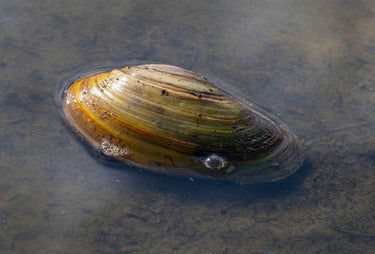
The swan mussel (Anodonta cygnea) is the biggest freshwater mussel found in British waters, reaching up to 20cm across a smooth, olive-to-brown oval shell. It spends its life half-buried in the silt at the bottom of the pond, drawing water in through one siphon and pushing it back out through the other — quietly working through suspended algae, phytoplankton and fine organic particles as it goes.
It is one of the few pond animals that genuinely earns its place through what it removes rather than what it eats off the surface. In a mature, silt-bottomed wildlife pond, a small group of swan mussels helps take the edge off green water and adds a piece of native aquatic life most ponds never get.
Please read the suitability section below before ordering. Swan mussels are not a substitute for a filter and they are not suitable for every pond. Sold to the wrong pond they will slowly starve, and we would rather sell you none than sell you five that die.
Why keep swan mussels
- Live filter feeders. Each adult mussel processes many litres of pond water a day, removing suspended algae and fine particulates that mechanical filters pass straight through.
- Host species for bitterling. European bitterling (Rhodeus amarus) lay their eggs inside a living mussel's gill chamber. Without swan or duck mussels, bitterling cannot breed. If you keep bitterling, this is the missing piece.
- Genuinely native. Anodonta cygnea is a British native in long-term decline. Established, silt-bottomed garden ponds are a real refuge for it.
- Long-lived and low maintenance. In the right pond a swan mussel needs no feeding and no intervention, and can live well over a decade.
- Fascinating to watch. They plough slow furrows through the silt with a muscular foot, leaving visible tracks along the pond bottom.
Is your pond suitable?
Yes, if your pond has:
- Been established and biologically mature for at least 12 months
- A soft bottom — at least 8–10cm of silt, mud, sand or fine gravel for the mussel to burrow into
- At least 1,000 litres (1m³) of water per mussel
- Some natural green water, algae or suspended organics — a slightly "living" pond, not gin-clear
- Gentle circulation and good dissolved oxygen
No, if your pond has:
- A bare liner or concrete base with nothing to burrow into
- A UV clarifier and heavy mechanical filtration keeping the water sterile and crystal clear — there will be nothing left in suspension for the mussel to eat, and it will starve over several months
- Been set up in the last year, or was recently drained and refilled
- Less than 1,000 litres, or is a preformed/patio pond
- Heavy predation pressure from herons or corvids in shallow margins
Blunt version: a swan mussel in a filtered, UV-clarified koi pond is a slow death sentence, and a large mussel dying unnoticed in a small pond can foul the water badly enough to kill fish. If you are buying these to clear a green pond, a barley straw treatment, more marginal planting or a proper UV unit will do that job — a mussel will not.
Care at a glance
| Species | Anodonta cygnea |
| Common names | Swan mussel, giant pond mussel |
| Adult size | Typically 12–17cm, up to 20cm |
| Lifespan | 10–15+ years in suitable conditions |
| Water temperature | 2–24°C (fully hardy outdoors in the UK) |
| pH | 6.8–8.0, neutral to slightly alkaline |
| Hardness | Up to 25°dH — they need calcium to build shell |
| Minimum pond volume | 1,000 litres per mussel |
| Substrate | 8–10cm+ of silt, mud, sand or fine gravel |
| Feeding | None required — filter feeder on algae, phytoplankton and fine detritus |
| Position | Pond floor, ideally 30cm+ deep, out of full sun |
Introducing your mussels
- Float the sealed bag in the pond for 20–30 minutes to equalise temperature.
- Open the bag and mix in pond water gradually over another 20 minutes.
- Place each mussel by hand onto the pond floor, narrow hinged edge down, at a slight angle into the silt. Do not simply drop them in — a mussel landing flat on its side may not right itself.
- Space them out rather than clustering them.
- Leave them alone. They will bury themselves within a day or two, and you may see nothing of them for weeks. That is normal.
Check occasionally that a mussel has not been lifted into the shallows or left gaping open on the surface of the silt. A shell that stays wide open and does not close when handled has died and should be removed promptly.
Compatibility
Fine with goldfish, orfe, rudd, tench, native amphibians, snails and all pond plants. Ideal alongside bitterling. Not recommended with koi, which will dig them out of the substrate, or in ponds stocked heavily enough that oxygen is already under pressure.
A note on breeding: swan mussel larvae (glochidia) attach briefly to the gills and fins of passing fish before dropping off as juveniles. This is a natural part of the life cycle and healthy fish are unaffected, but it is worth knowing about if you keep valuable or already-stressed fish.
Key facts
Planting & care
Most pond plants thrive in full sun, with at least 4–6 hours of sunlight daily for the best growth and flowering.
Plant aquatic plants in suitable aquatic baskets using aquatic compost to help support healthy root development and prevent soil from clouding the water.
Position plants at the correct water depth, as different varieties prefer marginal, shallow, or deep-water conditions.
Water lilies and oxygenating plants help improve water quality, provide shade, and create a healthier environment for fish and wildlife.
Planting help for this plant
Know what to plant, and when
A short message when there's a job to do or fresh stock in. Choose email, WhatsApp, or both.
- Email, WhatsApp, or both - tick the ones you want
- Planting reminders for the season you're in
- Unsubscribe any time - reply STOP on WhatsApp
We only message you about what you tick. Privacy Policy.